





The Bishop score is a basic assessment tool—your practitioner will use it to calculate how ready your cervix is for labour induction. It allows them to weigh key factors so that they can determine the best approach for you.
Understanding the Bishop score will help you make informed choices and navigate your own childbirth journey.
First things first: What is the Bishop score?
As pointed out, practitioners use the Bishop score to evaluate the readiness of your cervix for induction of labour. This is based on more findings during an internal exam. The total score—along with your individual factors—helps decide whether you need cervical ripening before labour induction.
Typically, a high Bishop score means your cervix is ready for induction. Lower score could indicate that it may need some ripening first.
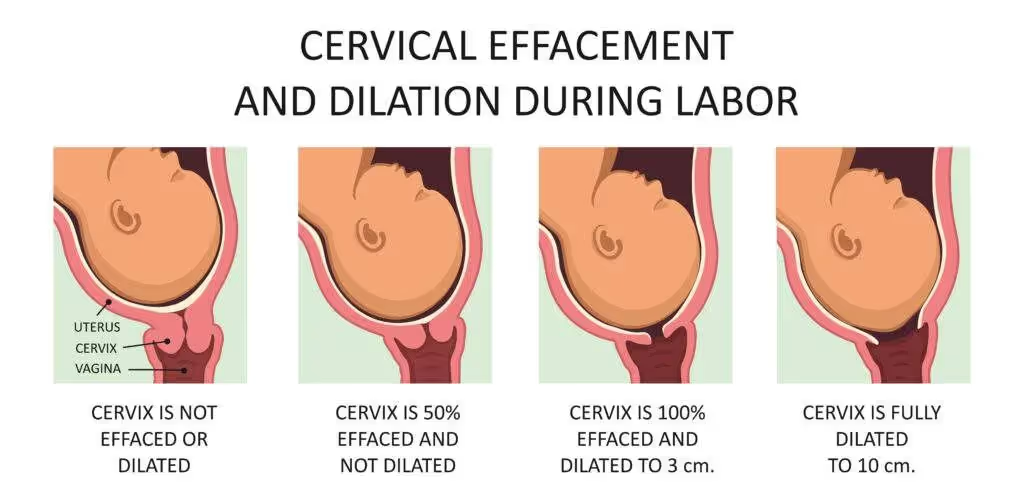
Key parameters of the Bishop score
The Bishop score evaluates 5 parameters of the cervix:
- Dilation: This refers to how open your cervix is. Initially, it is closed. During cervical ripening, it begins to dilate or open—this is measured in centimetres (cm). The cervix starts at 0 cm (closed) and eventually opens to 10 cm (fully dilated). That’s when it’s time to push. In the course of the ripening process, the cervix is commonly between 0–4 cm.
- Effacement: This is the thinning or shortening of your cervix. It starts off about 3–4 cm thick, and begins to thin as it ripens. Effacement or thinning is measured in percentages—starting at 0% (thick) to 100% (completely effaced). A fully effaced cervix is only about as thin as a piece of paper.
- Consistency/Softness: Initially, your cervix is a bit firm to the touch. As labour approaches, the tissue softens and it becomes pliable and flexible. This allows it to stretch and open. For example, feel the difference between the tip of your nose and your lips—this is comparable to the change in the softness of your cervix.
- Position: At the beginning, the opening of your cervix tilts away from the vaginal opening. As your body prepares for labour, it tilts towards the birth canal. This is measured as posterior, mid-position or anterior—posterior being tilted away and anterior directly aligned with the birth canal.
- Fetal position or station: This measures how engaged the baby’s head is in relation to your pelvis. As labour approaches, the baby descends further into the pelvis. Practitioners use negative and positive numbers to indicate this. The higher the negative number (up to -3), the less engaged it is. On the other hand—higher positive number (up to +3) shows that the head is deeper in the pelvis and birth canal.
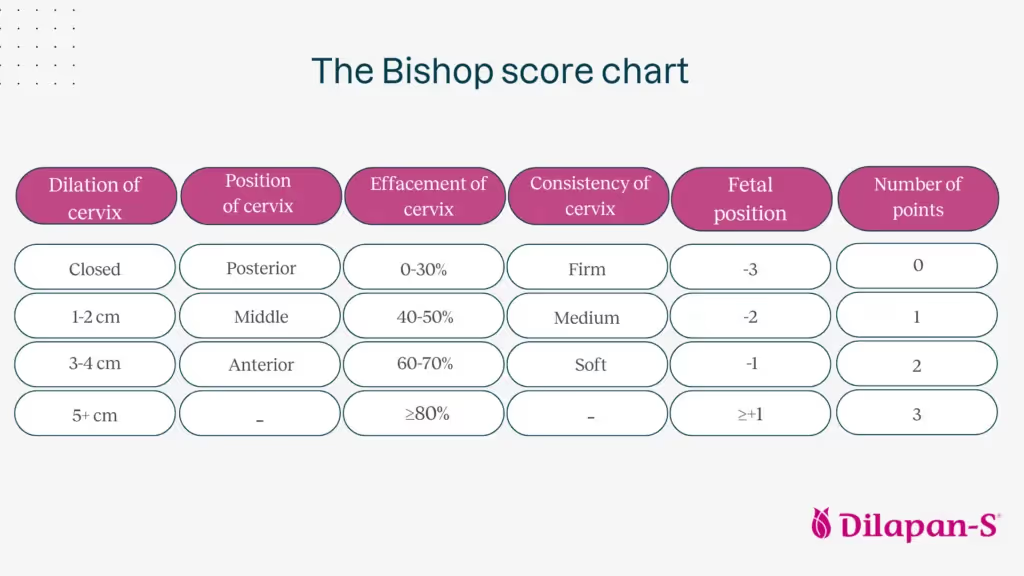
The Bishop score chart
There are more versions of the Bishop score, but the most common one ranges from 0–13. The higher the score, the more prepared your cervix is. With a score over 6, you typically wouldn’t need cervical ripening. Lower score indicates it is less prepared—your practitioner may recommend the ripening to increase the likelihood of a natural delivery.
For highly unripe cervixes—with initial Bishop score between 0–3—it is common to repeat the cervical ripening process to achieve at least a score of 6.
Cervical Ripening and the Bishop score
When the Bishop score is less than 6, cervical ripening is usually the first step in labour induction. This process can take time—at least several hours—and may even be repeated over the course of 18–24 hours. Together with your practitioner, you can discuss several methods.
Cervical ripening: Mechanical methods
Mechanical methods, such as membrane stripping, synthetic cervical dilator DILAPAN-S, or balloon catheter, are hormone-free. They can be used for most women, including those with a previous Caesarean section.
Mechanical methods have several modes of action. For example, after DILAPAN-S is inserted into the cervical canal, it begins to absorb fluids from the surrounding tissue of the cervix. This absorption is gradual and over time causes the dilators to slowly expand. The main mode of action for DILAPAN-S is opening the cervix however it also stimulates other important changes. The process of pulling fluid from the cervix causes the tissue to naturally soften, which, as mentioned, is an important change that occurs during the cervical ripening process. Another action is, as the dilators expands, the gentle stretching of the cervix stimulates the release of body´s own prostaglandins. This naturally occurring hormone also causes the cervix to soften and begin the thinning process. These multiple modes of action impact all the elements of cervical ripening, softening, thinning, and opening.
In the last decade, mechanical options have increased in popularity due to their safety profile and effectiveness. Methods like DILAPAN-S offer a gentle approach, which most women rate very highly in terms of satisfaction.

One piece of the journey
It’s important to keep in mind that the Bishop score is a subjective measurement based on physical touch and feel. Different clinicians may differ slightly in their exams.
And just as clinicians can vary, each woman and her body may respond differently to the process. As a result, the Bishop score is often just one factor when creating the best individual plan. Clinicians will commonly consider multiple more details—for example, two women with the same score can go through a different process based on their medical history, past and current pregnancy and individual circumstances.
Cervical ripening is a jog, not a sprint
No two women respond to cervical ripening the same way. For some, it may trigger spontaneous labour, while for others, it may be a gradual process. Just remember that both situations are normal.
On average, cervical ripening methods usually result in about a three-point improvement in the Bishop score. Women with lower initial scores may need to repeat the process to achieve a score above 6. Also, some practitioners may suggest breaking the water to enhance cervical ripening and progress towards labour.
Unique experience
Keep in mind that the differences in your response to the entire process are completely normal. What’s more, individualised care tailored to your unique needs is crucial in looking for the most suitable approach.
Understanding the Bishop score and its impact on the cervical ripening process helps you feel secure and anticipate the variations you may experience along the way. It empowers you to have informed conversations with your practitioner and recognize the uniqueness of your journey.
Monica Myron
- certified registered nurse
Disclaimer: This blog post is for informational purposes only and should not be considered medical advice. Always consult with your healthcare provider to address your individual needs and concerns.